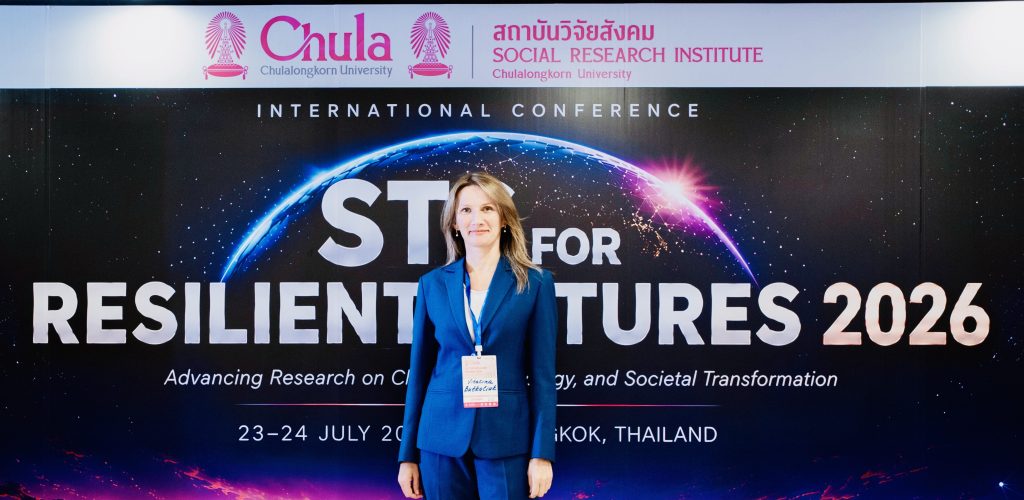
On 23–24 July 2026, I participated in the international conference STS for Resilient Futures 2026: Science, Technology, and Society in the Era of Climate and Digital Transition, organized by the Chulalongkorn University Social Research Institute (CUSRI) in Bangkok, Thailand.
The conference provided an international academic platform bringing together researchers, university representatives, and experts from different countries to discuss the relationship between science, technology, and societal transformation. Key topics included climate and digital transitions, sustainable development, social inequality, governance, ethics, and the broader social implications of technological change. One of the central ideas of the conference was to understand resilience not simply as society’s ability to adapt to change, but as a socio-technical process shaped by relations of power, governance, and social justice.
The interdisciplinary programme included sessions on artificial intelligence and robotics, digital transformation, climate and sustainable development, energy, urban environments, healthcare, ecology, space technologies, and other areas. The conference brought together researchers and invited experts from leading universities and institutions across Asia, Europe, Africa, Australia, and the United States.
As part of the conference, I presented a paper entitled “Social Risks of Artificial Intelligence in the Context of Digital Capitalism.”
In my presentation, I examined artificial intelligence as a technology developing within a specific economic and institutional environment — digital capitalism. The central question was why the development of AI generates not only new opportunities, but also new social risks and forms of inequality.
I argued that these risks go beyond the potential automation of particular types of work. They are also shaped by the concentration of capital, data, and computing infrastructure, changes in the structure of employment, and growing inequalities between different groups of workers and between countries.
Participation in STS for Resilient Futures 2026 was part of my ongoing research on social inequality, labour, and digital transformation, as well as my continued engagement with the academic community in Southeast Asia.
A full research article based on this study will be published soon. I will share it here once it is available.


Leave a comment